In a nutshell
- 🎯 Organising your space frees cognitive bandwidth, reduces context switching, and speeds entry into flow—use “first 60 seconds” stations to start fast.
- 🧭 Create zones (ideation, production, review) and mirrored digital setups with action-led templates; add friction to distractions for deeper focus.
- ⚖️ Minimalism isn’t always better: keep curated tools, prompts, and rewards in sight; match minimalist desks or curated clutter to your craft and energy needs.
- 🔁 Build daily rituals, clear constraints, and contextual cues (lighting, playlists), plus monthly micro-inventories to keep systems lean and reliable.
- ⏱️ Use a Five-minute reset: clear surfaces, name files with date + verb, set a single priority, stage materials, and remove one distraction—lower friction, faster idea-to-output.
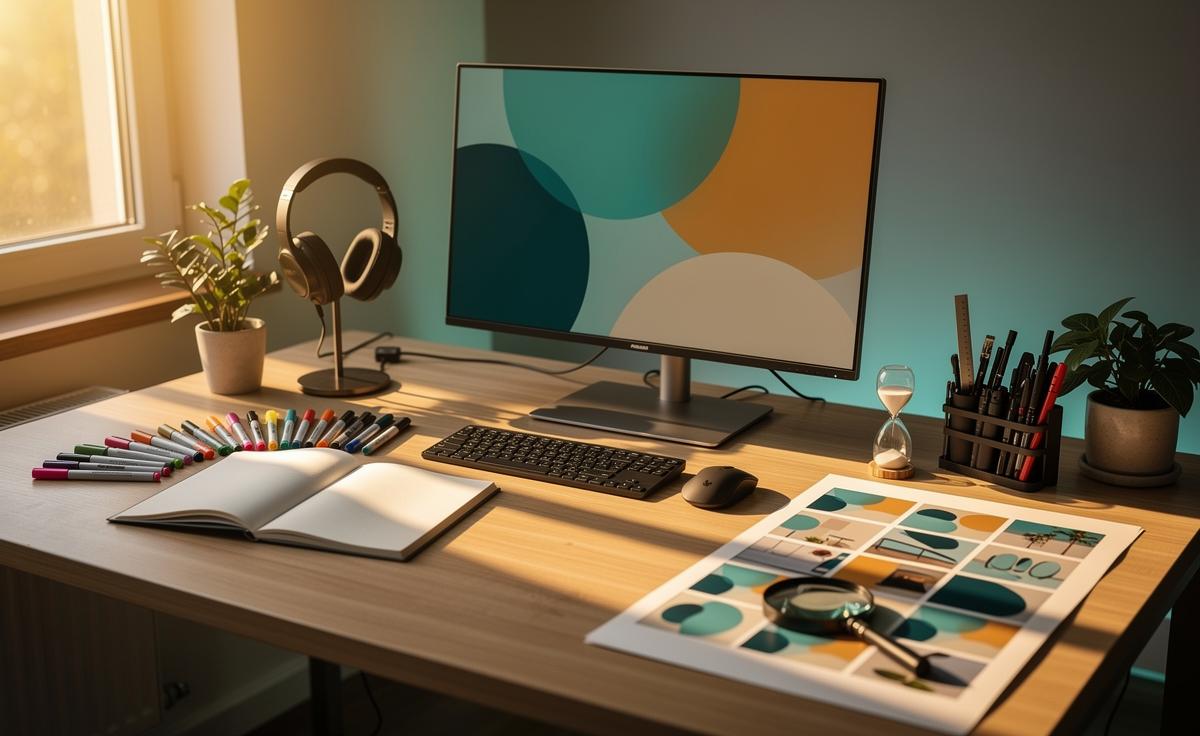
Creativity is not only a bolt of inspiration; it is the by-product of conditions we can design. In studios from Manchester to Margate, I’ve seen teams unlock better ideas simply by sorting their desks, tuning their screens, and setting gentle constraints. When you organise your workspace, you reduce noise, reclaim time, and give your brain room to wander productively. The right environment nudges your attention where it counts and protects it from where it frays. That isn’t about clinical minimalism; it’s about purposeful order—structures and rituals that help you think, sketch, test, and iterate without fighting your surroundings.
Order Frees Cognitive Bandwidth
The brain is a brilliant pattern-matcher but a poor juggler. Every stray cable, open tab, and unsorted note adds cognitive load, making it harder to reach the fluid state artists and coders call flow. Research on attention shows that clutter increases micro-decisions (“Where did I put that file?”), which accumulates into fatigue. When a workspace is tidy, working memory can prioritise ideas rather than logistics. Think of order as a creative tax rebate: you get back precious bandwidth for divergent thinking, and you feel more confident beginning a hard task because the ramp to “start” is shorter.
Consider the hidden cost of context switching. If your sketchbook is buried or your camera cable knotted, you are more likely to postpone experiments. Clear surfaces, labelled drawers, and repeatable digital folders function like rails on a track—the train moves faster because it knows where to go. Small acts of tidying compound into momentum. A practical prompt: create “first 60 seconds” stations—pen and pad in reach, a timer on the desk, a blank document template—so a single gesture can ignite a session before doubt has time to speak.
Designing Zones That Spark Flow
Great creative rooms behave like studios, not storage lockers. Divide your space into zones: an “ideation” area for rough work, a “production” zone for execution, and a “review” corner for edits and reflection. This doesn’t require a loft—only intention. Move the lamp, rotate your chair, or use a different keyboard theme to signal mode shifts. When cues match tasks, your brain anticipates what’s next and settles faster. In shared flats or busy offices, a portable caddy can carry a micro-studio: sketch tools, index cards, noise-cancelling earbuds, and a foldable laptop stand.
Digital zones matter as much as physical ones. Keep separate desktops or profiles: one pared back for writing or composing, another with heavy apps for editing. Preload templates named by verbs—“Pitch_Outline”, “Storyboard_Draft”, “Palette_Test”—so the file system suggests action. Reduce the steps from idea to artifact. To make zoning stick, add friction where distraction blooms: log out of social media on your work profile, hide nonessential icons, and batch notifications to arrive after your deep-work window.
- Ideation zone: blank paper, fat markers, timer, zero screens.
- Production zone: calibrated monitor, tidy shortcuts, colour-coded files.
- Review zone: neutral lighting, printed drafts, checklist for edits.
Why Minimalism Isn’t Always Better
There’s a myth that creativity demands stark minimalism. For some, empty desks reduce noise; for others, curated cues—books, textures, prototypes—prime memory and spark associations. The right level of order is the one that keeps tools reachable and meaning visible. A novelist might need a single notebook and a kettle; a product designer might benefit from a wall of swatches and test rigs. What matters is intentionality: everything in sight has a job, everything else is stored well and retrieved quickly.
Use a simple test: if an object is not a tool, a prompt, or a reward, relocate it. Tools serve the current task; prompts inspire or instruct; rewards make perseverance feel human. Clutter becomes creative only when it carries information or motivation. If you’re unsure, rotate artifacts monthly—freshness without hoarding. Below is a quick comparison to help you choose your baseline.
| Approach | Pros | Cons | Best For |
|---|---|---|---|
| Minimalist Desk | Low distraction; easy cleaning; fast reset | Fewer visual cues; can feel sterile | Writers, analysts, developers |
| Curated Clutter | Rich stimuli; memory anchors; tactile variety | Risk of mess creep; harder resets | Designers, artists, educators |
Rituals, Constraints, and Cues: The Daily Reset
Organisation isn’t a one-off clear-out; it’s a rhythm. Ritual turns order into culture. A two-minute “closing” routine—stack papers, archive the day’s draft with a date stamp, set tomorrow’s top task on a sticky—prepares Future You with kindness. Constraints amplify this effect: a single tray for active projects, a 30-minute weekly review, and a rule that every new tool must replace or upgrade an old one. These boundaries keep your system light and accountable, leaving room for the unexpected breakthrough.
Sound cues and scents can also nudge state. A short playlist signals “writing mode”; a desk lamp with a warm bulb marks “editing mode”. Pair that with micro-inventories: count your pens, cables, and notebooks monthly and note what actually gets used. When you own tools you trust and can find, you experiment more boldly. To embed the habit, try the five-minute reset below—small, repeatable, and surprisingly liberating.
- Minute 1: Clear surface: return tools to homes.
- Minute 2: Name and file today’s work with date and verb.
- Minute 3: List tomorrow’s single priority and two enablers.
- Minute 4: Stage materials for the first task.
- Minute 5: Remove one distraction from the room or desktop.
In the end, an organised workspace is a creative instrument: tuned regularly, it projects clarity and range. By lowering friction, sharpening cues, and respecting your attention, you shorten the distance from idea to outcome and make experimentation feel safe. Order doesn’t cage imagination; it sets it free to roam without getting lost. If you tried one change this week—zoning, a daily reset, or a refined toolset—which would most transform the way your ideas move from spark to tangible work, and what would tell you it’s working?
Did you like it?4.7/5 (23)