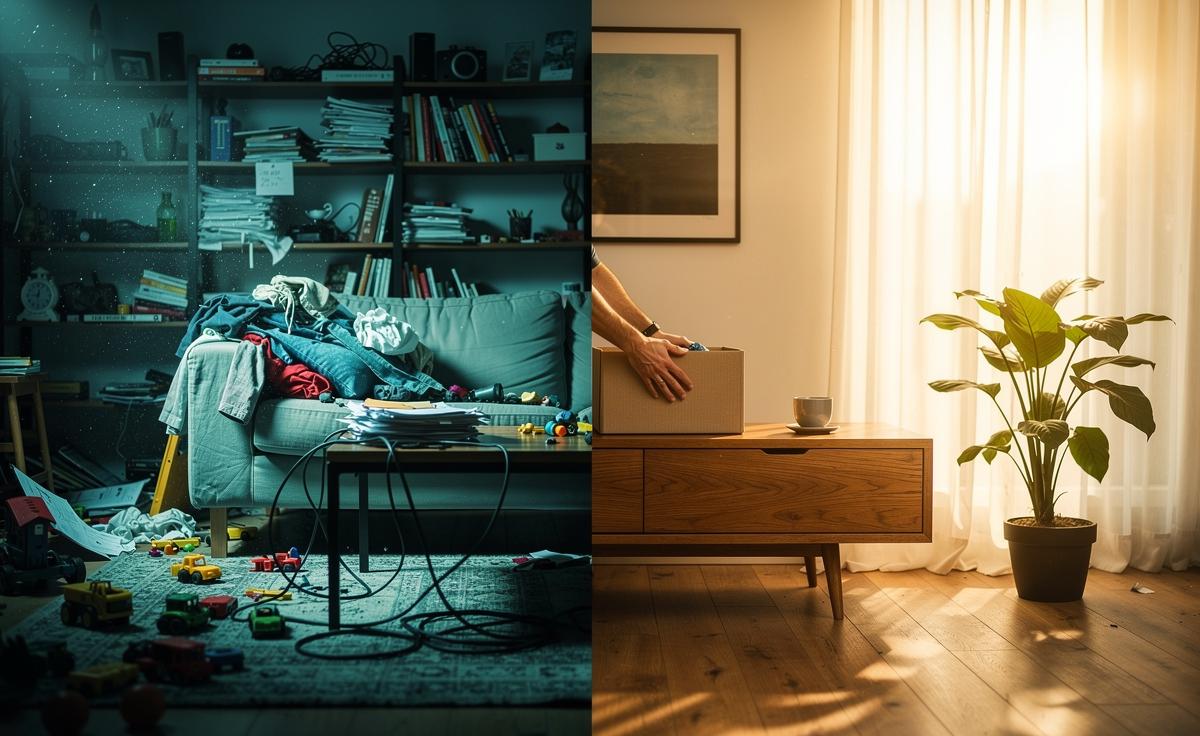
In a nutshell
- 🧠 Clutter overwhelms cognition by creating visual noise, decision fatigue, and attentional residue, raising stress and making home tasks feel endless.
- 🎯 Value-first curation keeps what serves daily function, creative work, or true memory; use the last-use test, replacement rule, role clarity, energy check, and one-in/one-out.
- 🛠️ Actionable steps: 48-hour reset, 90/90 rule, defined “homes for things” (drop zone, charging drawer), uniform containers and labels, time-boxed resets, paper clamp, and ethical exit plans.
- ⚖️ Pros vs. cons: Less cleaning, sharper focus, and lower spend vs. risks of over-editing, cold aesthetics, upfront decision fatigue, and the need for household consensus—mitigate with texture, plants, and a curated sentimental capsule.
- 🏡 Mindset shift: Treat clutter as feedback, not failure; create intentional zones, protect gains with light systems, and start small (bedside, desk, hallway hook) to build a calm minimalist haven.
Clutter doesn’t just crowd shelves; it colonises attention. In interviews for house features across the UK, I’ve heard the same refrain from busy parents, freelance creatives, and downsizers alike: “My home works against me.” The overwhelm is rarely about square footage. It’s the relentless pull of possessions that demand tracking, dusting, choosing, charging, and putting away. In practice, that means constant micro-decisions and low-grade stress. Here’s the twist: a minimalist haven is not austere or joyless. It’s an intentional environment tuned to your life’s signal, not its noise. Below, I explore why clutter overwhelms, and the concrete steps to craft a calm, purpose-built home.
Why Clutter Overwhelms the Brain
Clutter is not just “stuff”; it is unresolved choices. Neuroscience research links scattered visual input to increased cortisol and poorer task switching. Think of it this way: every item within eyesight consumes a sliver of attention, creating visual noise that burdens working memory. Over time, this triggers decision fatigue. You’d never open twenty browser tabs and expect your laptop to run smoothly; we do it to our minds daily. When everything is salient, nothing is salient. The result is procrastination, repeated purchases of duplicates, and a creeping sense that home maintenance is a second job you didn’t apply for.
A practical diagnostic is the object-to-surface ratio: how many objects sit on a given metre of surface? High ratios correlate with more cleaning time, lost keys, and delayed exits. Another cue: attentional residue. If you can’t relax in the sitting room because the book pile whispers “read me” and the unopened mail says “deal with me”, the environment is scripting your mood. Clutter ambushes you with intentions from yesterday. A minimalist haven flips that script, letting space cue rest, focus, or play—on demand.
Knowing What to Keep: A Value-First Method
Minimalism fails when it’s just subtraction. The winning move is value-first curation. In a recent London one-bed, Amira—a photographer—kept three cameras, not eleven, because only those three aligned with the work she actually books. We audited her flat by purpose: daily function, creative tools, meaningful mementos. Everything else went to donation or resale. Decluttering is editing a life in progress, not erasing it. This approach cuts guilt because your metric isn’t “how little can I live with?” but “what amplifies the week I truly live?”
Use these prompts to make fast, humane decisions—no perfectionism required:
- Last-use test: When did this earn its keep? Will it earn it this quarter?
- Replacement rule: If it vanished, would you notice within a month?
- Role clarity: Does it serve daily life, a current project, or true memory?
- Energy check: Does it add friction (extra cleaning, storage) or flow?
- One-in, one-out: New hoodie in? Old hoodie out—the category stays lean.
Document your rationale on a phone note for tricky items. It’s easier to let go when you’ve honoured the story, not just the space.
Practical Steps to Create a Minimalist Haven
Start with a 48-hour reset, room by room. Day one: remove everything from exposed surfaces; only essentials return. Day two: tackle hidden hotspots—drawers, baskets, under-bed storage. Touch every item once and decide its fate: keep, donate, sell, recycle. Use the 90/90 rule (used in the last 90 days or needed in the next 90?) to accelerate calls. Then design “homes for things”: a drop zone by the door, a labelled charging drawer, a laundry triage basket. The aim is a friction-light environment where tidying is measured in minutes, not weekends.
- Surface rule: One decorative item per small surface; two per large.
- Dupes audit: Keep your top two of any category; release the rest.
- Uniform containers: Same boxes, same labels—visual calm equals mental calm.
- Time-box: 30 minutes nightly reset; 2-hour monthly deep edit.
- Paper clamp: Scan, shred, and keep a single “action tray”.
- Ethical exit plan: Pre-book donation pickups; list sales on one chosen app only.
- Maintenance cue: Calendar recurring reminders tied to bin day or payday.
Your home should lower cognitive load, not raise it. These systems make that outcome reliable, not aspirational.
Minimalism Pros vs. Cons in Real Homes
Stripping back brings clarity—but there are trade-offs. Families may fear sterility, renters need flexibility, and creatives need visible prompts. The solution isn’t bare walls; it’s intentional density. Curate high-rotation items within reach and archive the rest. Create “zones” where abundance is allowed (toy trunk, studio pegboard) and zones where calm is protected (bedside, dining table). Below is a quick lens for decision-making—because why minimalism works depends on what you ask it to do.
| Pros | Cons |
|---|---|
| Less cleaning, faster resets | Risk of over-editing sentimental items |
| Sharper focus for work and rest | Spaces can feel cold without texture or colour |
| Lower spend via buy-better, buy-less | Upfront decision fatigue during the edit |
| Easy hosting—everything has a home | Shared households need consensus on standards |
Mitigate the cons with textiles, plants, a capsule of sentimental pieces on a single shelf, and household “agreements” for surfaces. Minimalism should feel human, not museum-like.
Clutter is a signal, not a moral failing. When you treat it as feedback—about projects you’ve outgrown, routines that don’t fit, or purchases that didn’t pan out—you can redesign the stage on which your week unfolds. Start small: a bedside, a desk, a hallway hook. Protect the gains with light, repeatable systems and a value-first lens. Space is not empty; it’s capacity for what matters. If you were to claim just one room this weekend as a calm, minimalist haven, which would you choose—and what’s the first item you’d retire to make it happen?
Did you like it?4.5/5 (26)