In a nutshell
- 🗺️ Use the Bagua map and place beds/desks in the command position to improve flow, sightlines, and calm in compact UK homes.
- 🧹 Treat clutter as stuck Qi; clear entryways, surfaces, and “doom drawers” to boost focus and ease—balance minimalism with a “joy shelf.”
- 💡 Layer lighting (ambient, task, accent) and align colours with the Five Elements; mirrors should expand light without reflecting beds or mess.
- 🌿 Choose materials and plants intentionally—soft textures to ground, rounded-leaf greenery for renewal—avoiding “more is better” traps.
- ⏱️ Build micro-rituals: air rooms daily, sweep entrances, set a weekly “prosperity tidy,” and use scent cues to anchor mood and intention.
Want to elevate your space from merely tidy to truly energising? The ancient Chinese art of feng shui offers practical, research-aligned ways to influence mood, focus, and wellbeing through layout and materials. In compact UK homes and rentals, small moves carry big impact: think smart furniture placement, balanced colours, and purposeful decluttering. Energy follows attention, so the places you see and touch each day shape how you feel and perform. Below, I share field-tested techniques, quick wins for flats and terraces, and a simple map to make sense of what goes where. Treat these as living guidelines—adaptable, personal, and surprisingly immediate.
Map Your Home’s Energy With the Bagua
Before buying another candle or cushion, plot your space with the Bagua, feng shui’s energy map. Place the grid over your floor plan with the bottom aligned to your main entrance wall. Each zone corresponds to an aspect of life—career, health, relationships—and to one of the Five Elements. For UK rentals, where structural changes are off limits, accessories and positioning do the heavy lifting. Use a smartphone compass to find rough directions, but don’t overthink it; clarity beats perfection. Start by identifying your front door and the centre of your home; anchor circulation so pathways are clear and sightlines are generous.
Prioritise the command position—the place in each room where you can see the door without being directly in line with it. Beds, desks, and sofas belong here. This reduces subconscious vigilance and steadies your nervous system, which is why clients often report better sleep and fewer procrastination spirals after a simple move. In tight London flats, consider diagonals: a desk angled to face the door or a bed offset to avoid headboard-under-window draughts. Small rotations can unlock big shifts, especially in rooms that feel flat or fidgety.
| Bagua Area | Element | Quick Boost |
|---|---|---|
| Career (Entrance) | Water | Dark blue runner, reflective tray, flowing artwork |
| Wealth (Back Left) | Wood | Healthy plant, vertical bookshelf, green accents |
| Fame (Back Centre) | Fire | Warm lighting, candles, splash of red or coral |
| Relationships (Back Right) | Earth | Pairs of items, soft textures, blush or terracotta |
| Health (Centre) | Earth | Open space, woven rug, balanced lighting |
| Helpful People (Front Right) | Metal | Metal bowl for keys, silver frames, tidy charging station |
Clear Clutter and Let Qi Flow
In feng shui, clutter is not a moral failing; it’s stuck Qi. Piles block pathways, overstuff shelves weigh on attention, and “doom drawers” hoard decision fatigue. Start with hotspots: the hallway drop zone, kitchen counters, and the bedroom floor. The aim isn’t austerity; it’s circulation. Give every daily item a labelled home—hooks for coats, trays for post, baskets for chargers. For sentimental objects, display a curated few and pack the rest in tidy, dated boxes. Your goal is a landscape of smooth transitions: doorways that invite, corners that breathe, shelves that hold rather than heave.
Consider Tom in Hackney, a sound engineer who felt permanently behind on life admin. We tackled his hallway first—adding a slim console with a bowl for keys, vertical shoe rack, and a bright runner “pulling” energy into the flat. Within a week, he reported 20 minutes saved each morning and fewer missed deliveries, a change he described as “more space in my head.” Clutter clearing also improves how light moves across a room, enhancing perception of width in narrow Victorian terraces. When in doubt, remove rather than add; subtraction reveals what the room wants to do.
- Pros: Better focus, easier cleaning, calmer mornings, clearer sightlines.
- Cons: Decision fatigue early on; risk of sterile feel if you purge personality.
- Balanced fix: One-in, one-out policy; seasonal review; keep one “joy shelf.”
Calibrate Light, Colour, and Materials
Light is the universal activator. Mix three layers—ambient, task, and accent—to avoid glare and gloom. South-facing rooms tolerate bolder hues and lighter curtains; north-facing spaces thrive with warm-white bulbs (2700–3000K) and reflective finishes. Mirrors are potent: place them to expand light or views, never to face the bed directly or bounce clutter. Brightness should soothe, not startle. Colour maps to the elements: greens for Wood (growth), reds for Fire (visibility), whites and greys for Metal (clarity), blues for Water (flow), and sandy neutrals for Earth (stability). Layer texture—linen, wool, rattan—to ground the scheme.
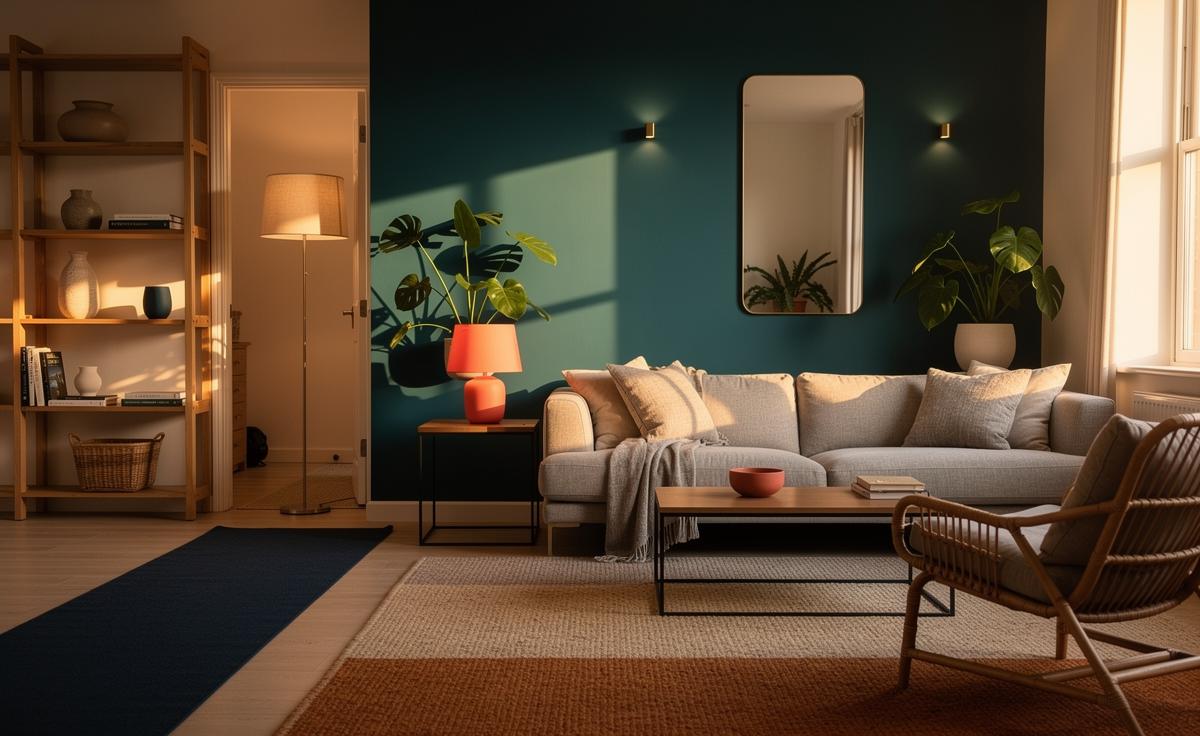
Use colour by intention, not trend. A small home office might take a deep teal accent behind the desk (Water feeding Wood for productivity), while a living room could balance soft neutrals with a single coral lamp (Fire for sociability). Plants oxygenate air and symbolise renewal, but they’re tools, not trophies. Avoid spiky varieties in restful zones; opt for rounded leaves. In bathrooms, a modest eucalyptus or fern invites gentle movement—just enough to animate still air. Harmony arises from balance: too much of any element skews the mood.
- Why Brighter Isn’t Always Better: Over-illumination raises visual stress; layer lamps and dimmers instead.
- Why More Plants Isn’t Always Better: Excess greenery increases humidity and maintenance; curate healthy, well-placed specimens.
- Material mix: Pair metal (clarity) with wood (growth) to avoid either feeling cold or cluttered.
Use Rituals and Daily Micro-Habits
Design sets the stage, but habits run the show. Begin with five-minute resets: open windows each morning for fresh Qi, sweep the entrance, and clear surfaces you’ll see within the first hour of the day. What you encounter first imprints the day’s tone. Place your bed and desk in command position; if you can’t, use a mirror to gain sight of the door. A small chime at the threshold or two deep breaths before you cross it help shift gears from commute to home. Scent anchors intention—think citrus in the kitchen, lavender in the bedroom, frankincense in meditation corners.
For renters and busy families, micro-rituals beat big overhauls. A salt-water bowl discreetly placed near the entrance for 24 hours absorbs heaviness after crowded weeks; dispose and rinse the bowl thoroughly. Set a weekly ten-minute “prosperity tidy” in your Wealth area: clear receipts, sweep, water a plant. In shared houses, a tray system keeps personal chaos from becoming communal friction. Finally, align actions to aims: if you’re courting focus, make a rule to shut lids and doors at day’s end—cupboards, laptops, even the loo seat. Every closure is a gentle boundary, teaching the home to hold you.
- Daily: Air rooms, clear entry, reset desk, water key plant.
- Weekly: Vacuum corners, refresh flowers, review one drawer.
- Monthly: Rebalance lighting, wash mirrors, revisit goals and adjust cues.
The beauty of feng shui is its pragmatism: design that listens, routines that reinforce, and a home that answers back. When your doorway welcomes, your bed restores, and your desk focuses, life begins to feel upstream. Start with one zone, one habit, one shift in sightline, and let results build your confidence. Keep a short journal of changes and how you feel over two weeks—you’ll spot patterns faster than you think. Which corner of your home is calling for attention today, and what’s the smallest, most courageously simple tweak you’ll make first?
Did you like it?4.3/5 (26)